

Web Developer Resume Format (US Edition)
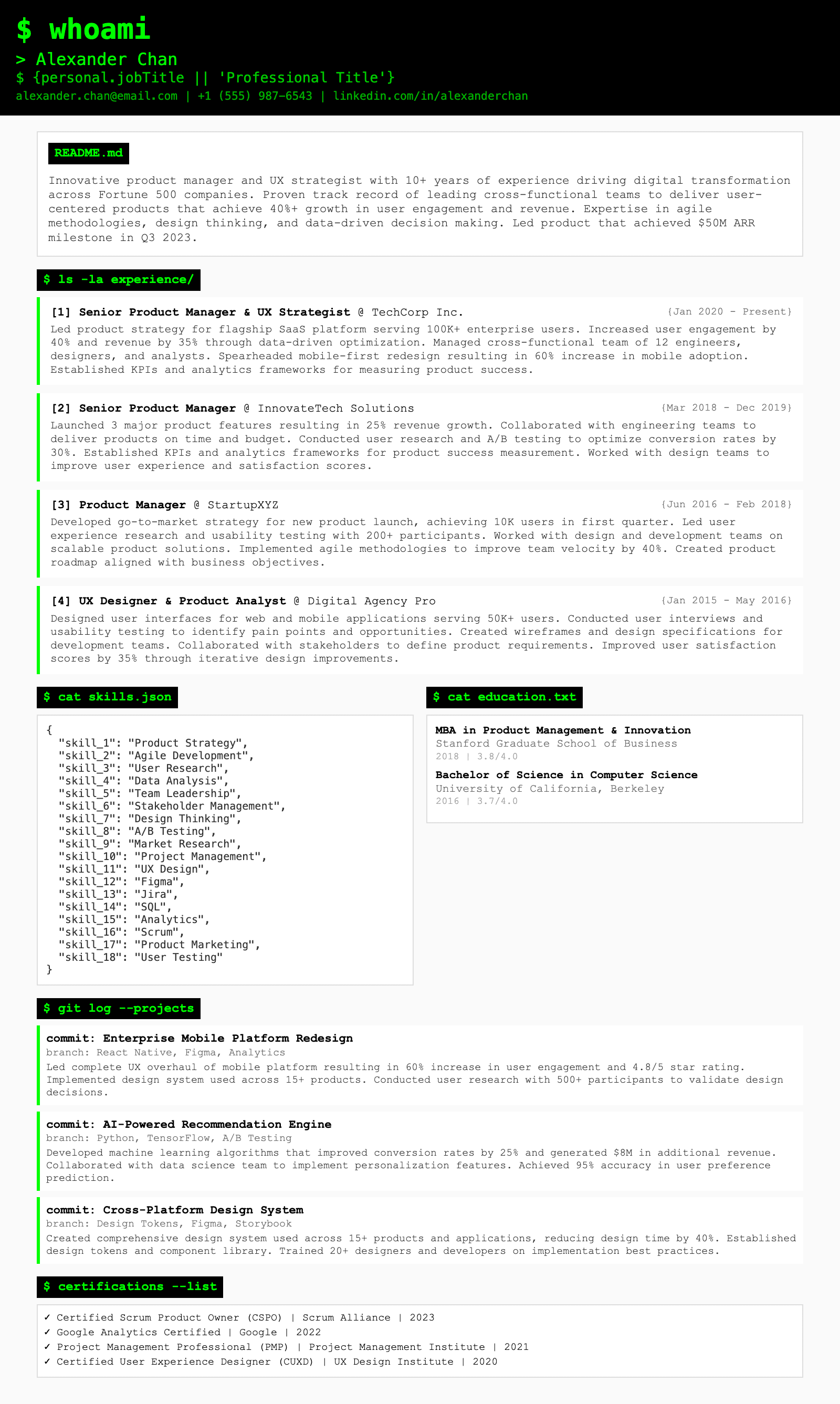
The US job market for Web Developers is highly competitive. Recruiters look for 'Action Verbs' and quantifiable achievements. This template is designed to pass ATS filters used by top US companies.

Salary Range
$85k - $165k
Use strong action verbs and quantifiable results in every bullet. Recruiters and ATS both rank resumes higher when they see impact (e.g. “Increased conversion by 20%”) instead of duties.
A Day in the Life of a Web Developer
A Web Developer's day often begins with stand-up meetings to discuss project progress and address roadblocks. Morning tasks frequently involve debugging code using tools like Chrome DevTools or Firebug, and implementing new features based on specifications defined in Jira or Asana. The afternoon can be spent writing and testing code in languages such as JavaScript (React, Angular, Vue.js), Python (Django, Flask), or PHP (Laravel). Collaboration is key, so expect code reviews via GitHub or GitLab. A significant portion of the day may be dedicated to database management using MySQL, PostgreSQL, or MongoDB, ensuring data integrity and optimizing query performance. The day concludes with planning for the next sprint, possibly involving estimation and task assignments. Deadlines for deliverables are often tracked using project management software.
Skills Matrix
Must Haves
Technical
Resume Killers (Avoid!)
Listing only job duties without quantifiable achievements or impact.
Using a generic resume for every Web Developer application instead of tailoring to the job.
Including irrelevant or outdated experience that dilutes your message.
Using complex layouts, graphics, or columns that break ATS parsing.
Leaving gaps unexplained or using vague dates.
Writing a long summary or objective instead of a concise, achievement-focused one.
Typical Career Roadmap (US Market)
Top Interview Questions
Be prepared for these common questions in US tech interviews.
Q: Describe a time you had to debug a particularly challenging piece of code. What steps did you take?
MediumExpert Answer:
In a recent project using React, I encountered a performance bottleneck that was causing slow rendering. I began by using the Chrome DevTools profiler to identify the components that were taking the longest to render. I discovered that a specific component was re-rendering unnecessarily due to a poorly optimized Redux selector. I refactored the selector to memoize the results, preventing unnecessary re-renders. This significantly improved the performance of the application, reducing rendering time by 40%.
Q: Tell me about a project where you had to work with a new technology or framework you weren't familiar with.
MediumExpert Answer:
When I joined a new team, they were transitioning to using Vue.js for their front-end development. I had prior experience with React, but not Vue. I dedicated time to learning the framework through online courses and documentation. I then volunteered to lead the development of a small feature using Vue. This allowed me to gain practical experience and contribute to the team's transition. Within a few weeks, I was proficient in Vue and able to contribute effectively to the project.
Q: How do you stay up-to-date with the latest trends and technologies in web development?
EasyExpert Answer:
I stay updated by regularly reading industry blogs like CSS-Tricks and Smashing Magazine, following influential developers on Twitter, and participating in online forums and communities like Stack Overflow and Reddit's r/webdev. I also attend webinars and online conferences to learn about new technologies and best practices. Additionally, I dedicate time to personal projects where I can experiment with new frameworks and tools.
Q: Describe a time you had to work with a tight deadline on a web development project. How did you manage your time and prioritize tasks?
MediumExpert Answer:
During a recent project, we had a strict deadline to launch a new feature for our e-commerce website. I prioritized tasks by focusing on the critical functionalities needed for the initial launch. I broke down the project into smaller, manageable tasks and used a Kanban board to track progress. I communicated regularly with the team to identify and address any roadblocks. We implemented a minimal viable product (MVP) approach, focusing on core features and postponing less critical ones for later iterations. We successfully launched the feature on time by using effective time management and communication.
Q: Explain the difference between REST and GraphQL APIs.
HardExpert Answer:
REST (Representational State Transfer) is an architectural style that uses standard HTTP methods to access and manipulate resources. It relies on multiple endpoints to retrieve data. GraphQL, on the other hand, is a query language for your API that allows clients to request specific data in a single request. GraphQL reduces over-fetching and under-fetching of data, leading to better performance, especially on mobile devices. REST is simpler to implement initially, while GraphQL offers more flexibility and efficiency for complex data requirements.
Q: Imagine a user reports a bug on a website you developed. Walk me through your process for identifying and fixing the issue.
MediumExpert Answer:
First, I'd gather as much information as possible from the user about the bug, including the steps to reproduce it, the browser and operating system they're using, and any error messages they encountered. Next, I would try to reproduce the bug on my local environment. If I can reproduce it, I'll use debugging tools like Chrome DevTools to inspect the code and identify the source of the problem. Once identified, I would implement a fix and write a test case to ensure the bug doesn't reappear. Finally, I would deploy the fix to the production environment and monitor the website to confirm that the issue is resolved.
ATS Optimization Tips for Web Developer
Use exact keywords from the job description, especially within your skills section and job experience bullet points. ATS systems scan for specific terms related to programming languages, frameworks, and tools.
Format your resume with clear, standard headings such as "Summary," "Skills," "Experience," and "Education." This helps the ATS parse the information correctly.
Submit your resume as a .docx or .pdf file. These formats are generally ATS-friendly and preserve your formatting better than older file types.
Avoid using tables, images, or unusual formatting elements. These can confuse the ATS and prevent it from accurately extracting information.
Quantify your achievements whenever possible. For example, instead of saying "Improved website performance," say "Improved website performance by 20% by optimizing database queries."
Include a skills section that lists both technical and soft skills. Separate them for clarity. Technical skills: JavaScript, Python, React. Soft skills: Teamwork, Problem-solving.
Tailor your resume to each specific job application. Highlight the skills and experiences that are most relevant to the position you're applying for, using the language from the job posting.
Ensure your contact information is easily accessible at the top of your resume. Include your name, phone number, email address, and LinkedIn profile URL.
Approved Templates for Web Developer
These templates are pre-configured with the headers and layout recruiters expect in the USA.


Common Questions
What is the standard resume length in the US for Web Developer?
In the United States, a one-page resume is the gold standard for anyone with less than 10 years of experience. For senior executives, two pages are acceptable, but conciseness is highly valued. Hiring managers and ATS systems expect scannable, keyword-rich content without fluff.
Should I include a photo on my Web Developer resume?
No. Never include a photo on a US resume. US companies strictly follow anti-discrimination laws (EEOC), and including a photo can lead to your resume being rejected immediately to avoid bias. Focus instead on skills, metrics, and achievements.
How do I tailor my Web Developer resume for US employers?
Tailor your resume by mirroring keywords from the job description, using US Letter (8.5" x 11") format, and leading each bullet with a strong action verb. Include quantifiable results (percentages, dollar impact, team size) and remove any personal details (photo, DOB, marital status) that are common elsewhere but discouraged in the US.
What keywords should a Web Developer resume include for ATS?
Include role-specific terms from the job posting (e.g., tools, methodologies, certifications), standard section headings (Experience, Education, Skills), and industry buzzwords. Avoid graphics, tables, or unusual fonts that can break ATS parsing. Save as PDF or DOCX for maximum compatibility.
How do I explain a career gap on my Web Developer resume in the US?
Use a brief, honest explanation (e.g., 'Career break for family' or 'Professional development') in your cover letter or a short summary line if needed. On the resume itself, focus on continuous skills and recent achievements; many US employers accept gaps when the rest of the profile is strong and ATS-friendly.
How long should my Web Developer resume be?
Ideally, a Web Developer resume should be one to two pages long. For entry-level or those with less than five years of experience, stick to one page. If you have extensive experience, particularly with multiple projects showcasing your expertise in various frameworks like React, Angular, or Node.js, two pages are acceptable. Focus on the most relevant and impactful projects and skills. Ensure that every piece of information adds value to your candidacy.
What are the most important skills to highlight on my Web Developer resume?
The key skills to emphasize depend on the specific role, but generally include proficiency in front-end technologies (HTML, CSS, JavaScript, React, Angular, Vue.js), back-end languages (Python, Java, Node.js, PHP, Ruby), database management (MySQL, PostgreSQL, MongoDB), cloud services (AWS, Azure, Google Cloud), and version control (Git). Highlight your problem-solving abilities and experience with different software development methodologies (Agile, Scrum). Tailor your skills section to match the requirements of each job description.
How can I optimize my Web Developer resume for Applicant Tracking Systems (ATS)?
To optimize your resume for ATS, use keywords directly from the job description, particularly in your skills and experience sections. Avoid using tables, images, or unusual formatting that an ATS might not be able to parse correctly. Save your resume as a .docx or .pdf file, as these are generally ATS-friendly formats. Use clear and concise language, and organize your resume logically with standard headings like "Summary," "Skills," "Experience," and "Education."
Are certifications important for a Web Developer resume?
Certifications can significantly enhance your resume, especially if you're transitioning into a new area or lack formal education. Relevant certifications include AWS Certified Developer, Microsoft Certified Azure Developer, Google Cloud Certified Professional Cloud Architect, and certifications in specific programming languages or frameworks (e.g., Certified JavaScript Developer). Certifications demonstrate your commitment to continuous learning and validate your skills to potential employers.
What are some common mistakes to avoid on a Web Developer resume?
Common mistakes include listing outdated or irrelevant skills, failing to quantify achievements, using vague language, and having typos or grammatical errors. Always proofread your resume carefully. Avoid generic descriptions and focus on specific projects where you applied your skills and achieved measurable results. Ensure your contact information is accurate and up-to-date. Tailor your resume to each job application, highlighting the skills and experiences most relevant to the specific role.
How do I showcase my skills when transitioning to Web Development from a different career?
When transitioning to Web Development, highlight transferable skills from your previous role, such as problem-solving, analytical thinking, project management, and communication. Focus on any relevant projects you've completed, even if they were personal or freelance. Emphasize your passion for learning and your commitment to developing your skills. Consider including a portfolio of your work to showcase your abilities and experience. Mention online courses, bootcamps, or certifications you've completed to demonstrate your dedication to web development.
Sources: Salary and hiring insights reference NASSCOM, LinkedIn Jobs, and Glassdoor.
Our CV and resume guides are reviewed by the ResumeGyani career team for ATS and hiring-manager relevance.